
Reconstruction works
Al Sharif Street
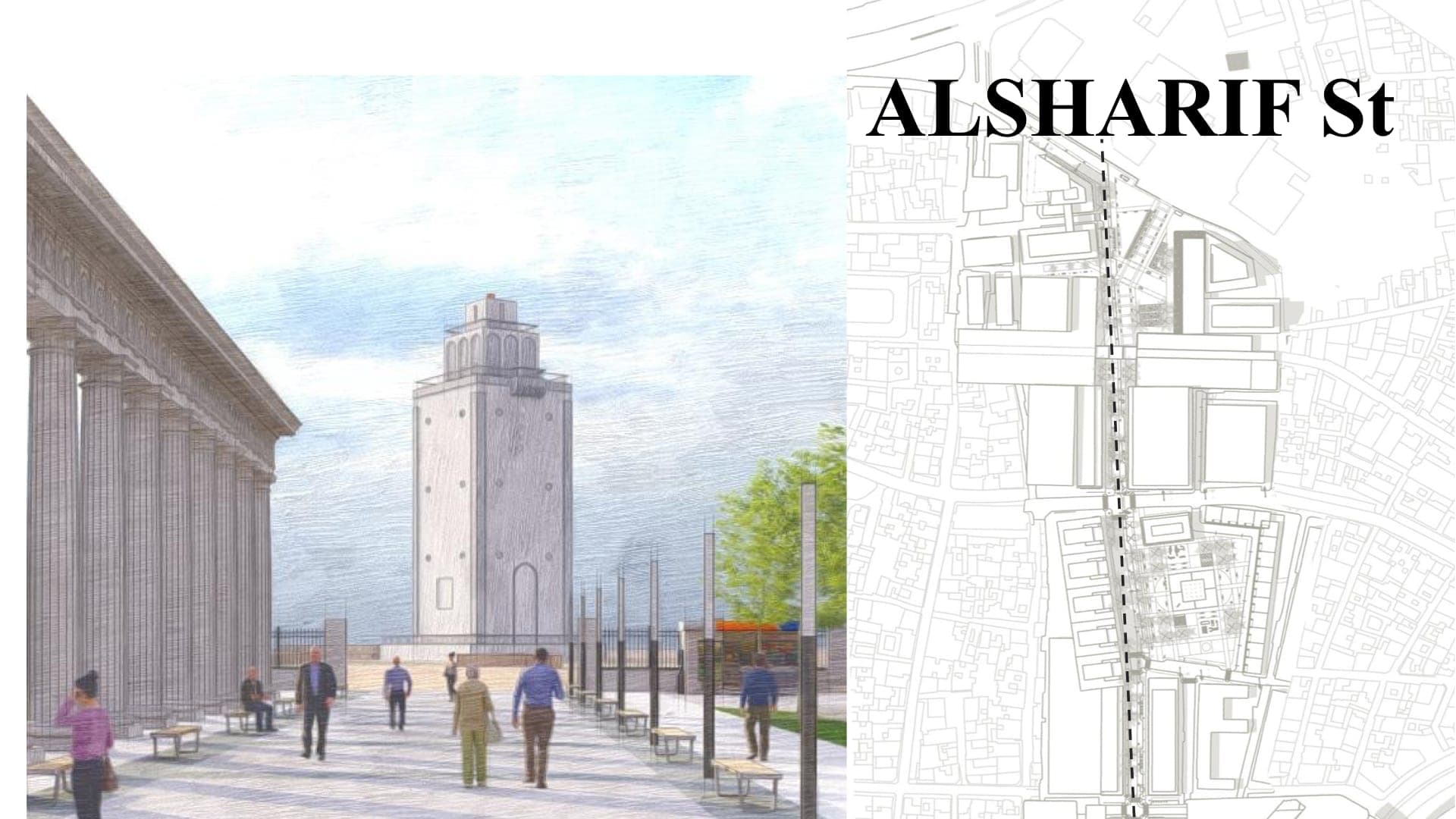
A reimagined Al Sharif Street: a calmed, mixed-use corridor that connects the Lighthouse and Tomb of Omar Al-Mukhtar through widened sidewalks, dedicated cycle lanes, and shaded public space.
About this project
Overview
Al Sharif Street is one of the central arteries of the Benghazi city centre regeneration. The proposal reshapes the street into a calmed, mixed-use corridor that connects key heritage landmarks — including the Lighthouse and the Tomb of Omar Al-Mukhtar — through a continuous sequence of widened sidewalks, planted edges, and shaded public space.
Design intent
- Calm traffic with a narrower carriageway and clearer pedestrian priority.
- Add generous, shaded sidewalks with seating, lighting, and landscape.
- Introduce dedicated cycle lanes and cycle corrals along the corridor.
- Improve pedestrian crossings and street geometry at junctions.
- Preserve sightlines toward the Lighthouse and Tomb of Omar Al-Mukhtar.
- Reinforce commercial frontages with active ground-floor uses.
Cross-section principles
The street is organised around six bands — building edges, sidewalks, landscape, cycles, parking, and the carriageway — sized for comfort and accessibility. Typical sidewalk widths are 2 metres, with 4 metres reserved for the central carriageway and dedicated bands for cycling and street furniture.
Public realm improvements
- Energy-efficient street lighting along the full corridor.
- Shaded seating bays and small cultural gardens at key intersections.
- Green infrastructure to manage stormwater and reduce heat.
- Coordinated paving and street furniture aligned with the City Centre identity.