
Travaux de reconstruction
Rue Al-Sharif
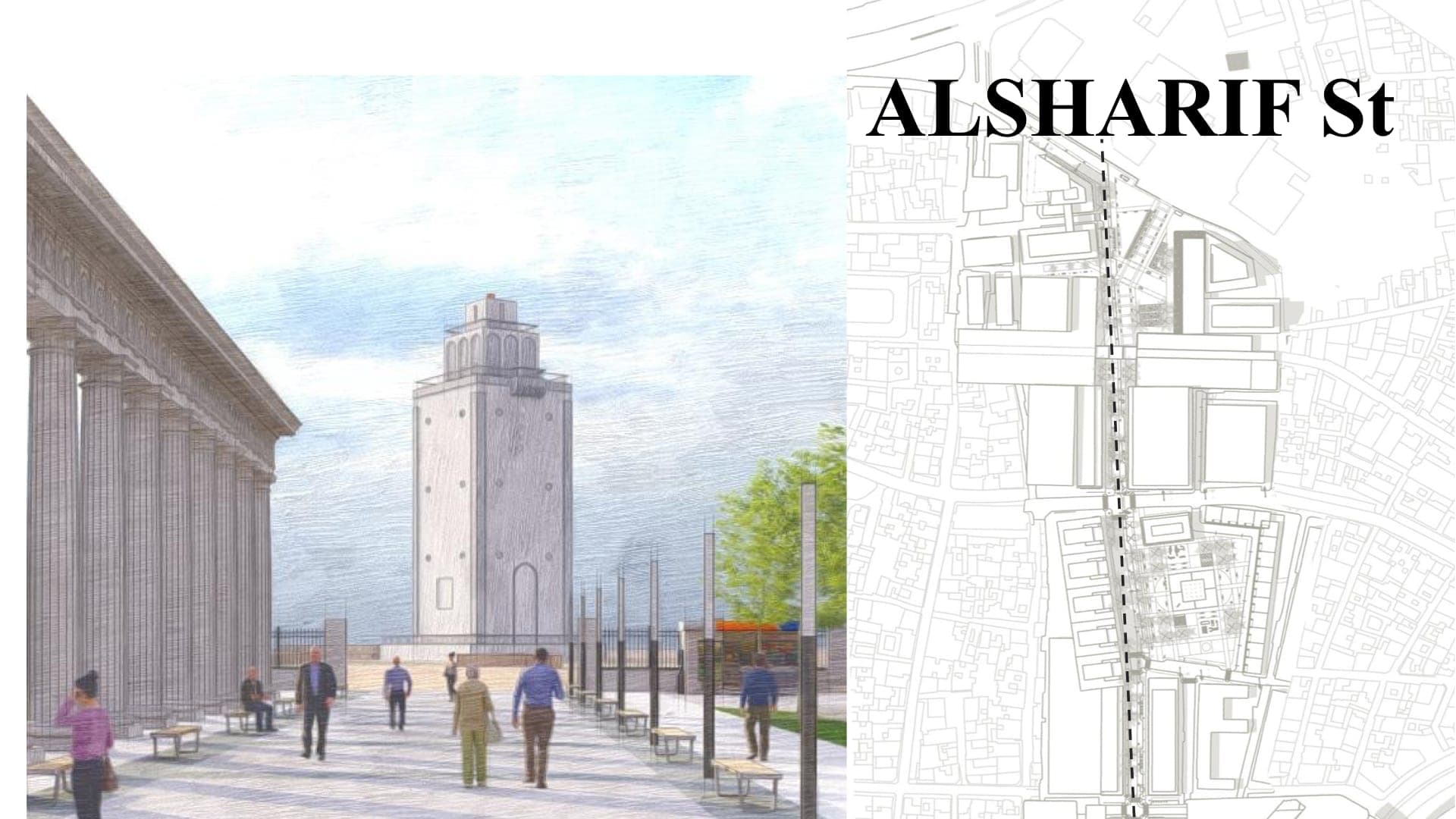
Une rue Al-Sharif réinventée : un corridor apaisé à usages mixtes qui relie le Phare et le Tombeau d'Omar Al-Mukhtar par des trottoirs élargis, des pistes cyclables dédiées et des espaces publics ombragés.
À propos de ce projet
Overview
Al Sharif Street is one of the central arteries of the Benghazi city centre regeneration. The proposal reshapes the street into a calmed, mixed-use corridor that connects key heritage landmarks — including the Lighthouse and the Tomb of Omar Al-Mukhtar — through a continuous sequence of widened sidewalks, planted edges, and shaded public space.
Design intent
- Calm traffic with a narrower carriageway and clearer pedestrian priority.
- Add generous, shaded sidewalks with seating, lighting, and landscape.
- Introduce dedicated cycle lanes and cycle corrals along the corridor.
- Improve pedestrian crossings and street geometry at junctions.
- Preserve sightlines toward the Lighthouse and Tomb of Omar Al-Mukhtar.
- Reinforce commercial frontages with active ground-floor uses.
Cross-section principles
The street is organised around six bands — building edges, sidewalks, landscape, cycles, parking, and the carriageway — sized for comfort and accessibility. Typical sidewalk widths are 2 metres, with 4 metres reserved for the central carriageway and dedicated bands for cycling and street furniture.
Public realm improvements
- Energy-efficient street lighting along the full corridor.
- Shaded seating bays and small cultural gardens at key intersections.
- Green infrastructure to manage stormwater and reduce heat.
- Coordinated paving and street furniture aligned with the City Centre identity.